Burn & Scarce Traits EXPLAINED! Full Guide & Tier List | Hunt: Showdown 1896
Intro:
Hi guys, Rex here,
And welcome to my Ultimate Trait Guide & Tier List series for Hunt: Showdown 1896.
I’ll be breaking traits down into seven categories, with each video covering one group and gradually building a complete tier list as the series goes on.
For each trait, I’ll show you exactly what it does with visual examples, share relevant insights, synergies, and lesser-known interactions, and then rank it based on overall value and impact.
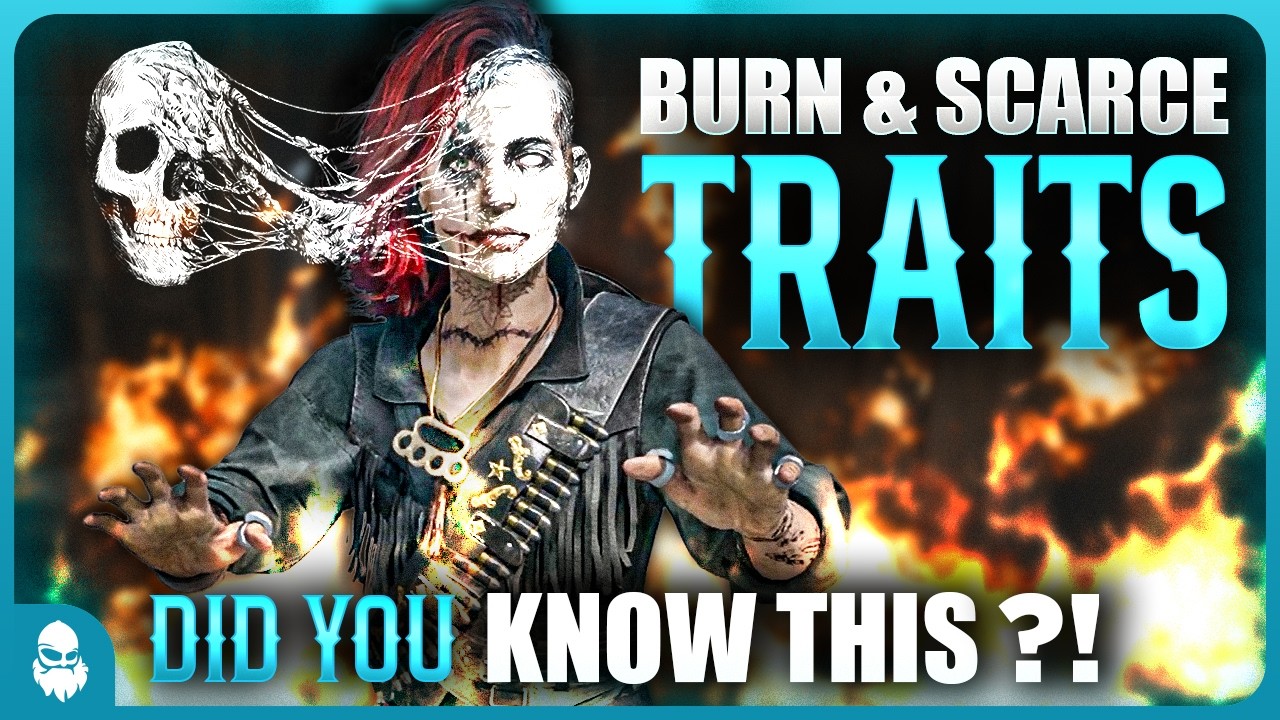
This first part focuses on Burn traits and Scarce traits. Burn traits are spent upon use and are easy to recognize by their red appearance. Scarce traits, on the other hand, can only be found during a match, and are recognized by their blue color. Some traits fall into both categories, meaning they’re found in-game and consumed upon use, like Death Cheat for example.
But without further ado, let’s dive into it!
1. Necromancer (Burn Trait)
First up, we have Necromancer. This is a burn trait that allows you to revive a downed teammate remotely through Dark Sight from up to 25 meters away, without ever having to physically reach their body. If you’re playing solo, Necromancer also allows you to revive yourself after being downed, effectively giving you a second chance in the same match.
There are a couple of important details that many players don’t realize. Burning is actually paused while Necromancer is channeling on a teammate who’s on fire, which can buy you time in a pinch. That said, once a Hunter is fully burned out, Necromancer can no longer be used on them, and for solos, being burned out completely removes your ability to self-revive.
It’s also worth mentioning that Necromancer can be replenished through the Empress tarot card, which grants Necromancer first, then Catalyst, and finally a random burn or scarce trait.
Necromancer is hands down one of the most powerful traits in the entire game and not taking it either solo or in a team leaves you at a clear disadvantage. Very little can compete with having a safe way to revive a teammate from a distance or getting a second chance after dying as a solo. Because of how much this trait can completely flip fights and change outcomes, I’m putting Necromancer firmly in the S tier.
2. Death Cheat (Burn/Scarce)
Next up, we have Death Cheat. This is a burn and scarce trait that prevents you from losing your Hunter if you fail to extract. You’ll still lose your gear, but the Hunter itself lives to die another day. Or more likely in the next game. We’ve all been there.
Death Cheat is especially useful if you’re trying to max out Hunters, since you don’t lose your progress following a death. That includes any levels, traits and trait points you acquired. Death Cheat is also extremely strong while prestiging. Once a Hunter reaches max level, all experience gained goes straight to your Bloodline, which means keeping that Hunter alive lets you prestige much faster — something I cover in far more detail in my prestige guide.
Because Death Cheat lets you keep your Hunter even after dying, reduces risk massively, and directly speeds up long-term progression, this is an easy S tier trait for me.
3. Rampage (Burn/Scarce)
Next up is Rampage. This is a burn and scarce trait that triggers a full Restoration when you kill an enemy Hunter while at least one of your health chunks are missing.
Rampage can be incredibly clutch in situations where you simply don’t have time or space to heal normally. I also find it very consistent when playing scoped loadouts, since you can sit back, take low-risk fights, and wait for the perfect opportunity to secure a kill and instantly regain your health.
That said, it’s still a situational trait. You need to be missing a chunk, and you need to land the kill, which means it’s not something you can rely on every game. Because of that, even though it’s very strong when it works, I’m putting Rampage in the A tier.
4. Relentless (Burn/Scarce)
Next up, we have Relentless. This is a burn and scarce trait that prevents you from losing a health chunk when you’re downed. There is an important detail to be aware of though. After being revived, the recovered bar comes back with twenty-four points of charcoaling, which means you’re effectively at low health until that damage is healed, and this takes quite some time. While the difference between 150 and 126 health may not seem that big, this means you’re temporarily a 1-shot to the torso for a lot of the more powerful weapons in the game. In practical terms, Relentless keeps your bar—but it still leaves you much easier to kill until that charcoaling is healed.
What’s interesting here is that charcoaling recovery can actually be sped up. The wet status effect increases the recovery speed, and so does the Vigor trait, and these effects stack. That means if you have Vigor and either enter water or get hit by a water bottle, you can enter Dark Sight and recover that charcoaling extremely quickly.
Relentless is primarily a teamplay trait, and in coordinated teams it can be very impactful. For solos, however, it has no meaningful effect, since self-revives through Necromancer already grant a full Restoration.
Following the recent nerf that added charcoaling to the recovered bar, Relentless is significantly weaker than it used to be. Before that changed, I would have comfortably placed it in the A tier for team play, but as it stands now, I’m placing Relentless in the B tier. It’s still a solid trait, just no longer a top priority.
5. Remedy (Burn/Scarce)
Next up, we have Remedy. This is a burn and scarce trait that allows you to trigger a full Restoration for your entire team by channeling on a nearby trait while using Dark Sight.
Remedy is incredibly powerful for a couple of reasons. First of all, it can be channeled on any trait, including sealed traits found at supply points, event compounds, towers, and similar locations. That gives you a level of predictability, because you can often plan ahead for where and when you’ll be able to use it. On top of that, Meatheads and Brutes very frequently drop traits, which means you can deliberately target them when you need a team Restoration.
The effect itself is also extremely strong. Remedy restores the entire team at once, which can completely reset a fight if multiple players are missing health chunks. Being able to activate this from Beetle view is another huge advantage, since you can fly a beetle out to scan for traits in situations where leaving cover is risky.
There’s also a lot of value beyond the Restoration itself. Remedy allows you to see nearby traits in Dark Sight, which is useful information on its own. And because Remedy can be intentionally burned by channeling on another trait — even if you don’t actually need the Restoration — it’s basically a no-brainer to pick up whenever you have the room. If you later find something more important, you can just burn Remedy and replace it.
Because of its versatility, reliability, and excellent team value, I’m placing Remedy in the A tier. It’s a fantastic trait for coordinated teams, even if its value for solos is relatively low.
6. Shadow Leap (Scarce)
Next up, we have Shadow Leap. This is a scarce trait that, on paper, sounds incredibly powerful. It allows you to channel a nearby AI through Dark Sight, teleport to its location, and kill it in the process. This does not work for stronger AI like Meatheads, Brutes, Bosses and Wild Targets.
You can tell through dark sight if shadow leaping onto an AI will damage you by the glow it emits, which helps prevent blowing up immolators and losing a lot of your health in the process.
In practice, Shadow Leap heavily underdelivers. The channeling takes some time, and you take damage as part of the channeling itself, which already limits when and how safely you can use it. On top of that, most AI tends to get cleared out fairly early in the match. That means the longer a game goes on, the fewer viable targets you actually have.
There are definitely situations where Shadow Leap can come in clutch, but they’re rare. Most of the time, I don’t even pick this trait up unless I have plenty of open trait slots and it drops for free. More often than not, it ends up being a wasted slot that could have been used on something far more impactful.
Because of how situational it is and how rarely I actually get any value out of it, I’m placing Shadow Leap in the C tier. It’s not completely useless, but it’s easily the weakest of the burn and scarce traits, and a trait I think should be reworked to be more consistently useful. When the trait was originally launched, you were actually able to teleport to meatheads, which was a great way to kill them, and a bit more consistent since they get killed less frequently than other AI.
7. Berserker (Scarce)
Next up, we have Berserker. This is a scarce trait that doubles all melee damage, and while that sounds incredibly strong, it’s important to separate PvE and PvP value here.
In PvP, most melee weapons already have excellent one-tap potential against Hunters, so Berserker doesn’t actually add all that much in most fights. Where this trait really shines is in PvE. Bosses, Wild Targets, and stronger AI become significantly easier and faster to deal with, which is especially valuable in risky solo scenarios where prolonged boss fights can get you killed.
There’s also a lesser-known interaction a lot of players miss. Berserker synchronizes with throwable, world-found melee weapons like shovels, axes, hammers, and pitchforks. Because the throw counts as melee damage, the damage gets doubled, and since throwing these weapons already deals more damage than normal swings, this becomes an extremely effective way to heavily damage bosses very quickly.
Because Berserker is primarily a PvE-focused trait with limited impact in PvP, I’m placing it in the B tier. It’s very strong in the right situations, especially for solos, but it doesn’t compete with top-tier combat traits overall.
8. Catalyst (Scarce)
Next up, we have Catalyst. This is a scarce trait that amplifies other traits with conditional Catalyst effects, which means its value is entirely dependent on what you’re already running.
Some of these effects can be very strong. With Kiteskin, you can no longer die from fall damage. Vigilant gets its trap detection range doubled. And if you’re playing solo with Frontiersman, you gain two extra tool charges instead of one, which applies to things like medkit uses, throwable charges such as the spear, penny shot Derringer ammo, traps, and more.
Beastface is another notable one. With Catalyst, animals won’t get startled at all — birds, horses, chicken and dog pens, bats, cows, all of it — which provides excellent stealth value. Pain Sense also gains an effect, allowing you to detect players who are out of stamina. However, in my opinion, the Pain Sense and Kiteskin synergies are far too situational to be worth planning around. They’re nice bonuses if you’re already running those traits, but not strong enough on their own to justify taking Catalyst for them specifically.
In practice, the real value of Catalyst comes from the Frontiersman synergy when you’re playing solo, and potentially Beastface if you’re going for stealth. The other effects are solid, but not nearly as significant — good to have if they happen to line up with your build, but not something I actively build around. The Vigilant effect is a small, but non-essential, quality-of-life bonus since the extra range usually isn’t that important.
It’s also worth mentioning that Catalyst is guaranteed after Necromancer when using the Empress tarot card, which we talked about earlier, provided you have 2 or more trait slots available.
The downside of Catalyst is that it takes up a trait slot, and trait slots are extremely valuable given how many strong traits exist in the game. Because its value is so dependent on very specific setups, I’m placing Catalyst in the B tier. I’ll generally only run it as a solo alongside Frontiersman, Vigilant, and possibly Beastface.
9. Shadow (Scarce)
Next up, we have Shadow. This is a scarce trait that prevents AI from seeing and attacking you, while still allowing them to hear you, and this is one of those traits that can make a massive difference when used correctly.
Shadow gives you a huge amount of control over how you move through the map. You can effectively ignore AI when you’re under pressure, tactically leave monsters behind for other teams to deal with, or keep them alive as a fallback option for retreating. It’s also incredible for stealth and survivability. You don’t need to make noise killing AI, you can choose exactly what you want to kill and when, and you can even fight tankier AI like Brutes and Meatheads without getting hit at all.
There is one important downside to be aware of in team play. If only one or two players in a team have Shadow, the remaining players without it will draw all the AI aggro. That puts them at higher risk of taking damage or dying, and you also lose most of the stealth benefit since someone still has to make noise dealing with the AI.
Because of how much value Shadow provides for stealth, survivability, and map control, I’m placing it in the S tier. Just keep in mind that it works best when everyone on the team has it.
Outro:
And that wraps up Part One of my Ultimate Trait Guide & Tier List.
In this video, we covered Burn traits and Scarce traits, why some of them are game-changing, why others are far more situational, and where they belong on the tier list based on real, practical impact.
In Part Two, we’ll be moving on to healing, restoration, and damage mitigation traits — breaking down how they affect survivability, fight tempo, and long engagements, and continuing to flesh out the tier list as the series goes on.
If this was helpful, make sure to subscribe so you don’t miss the next part — and if I missed something or you disagree with any of these placements, let me know in the comments. I’m always interested in hearing how other players are getting value out of different traits and synergies.
Thanks you for watching, and I’ll see you in Part Two.