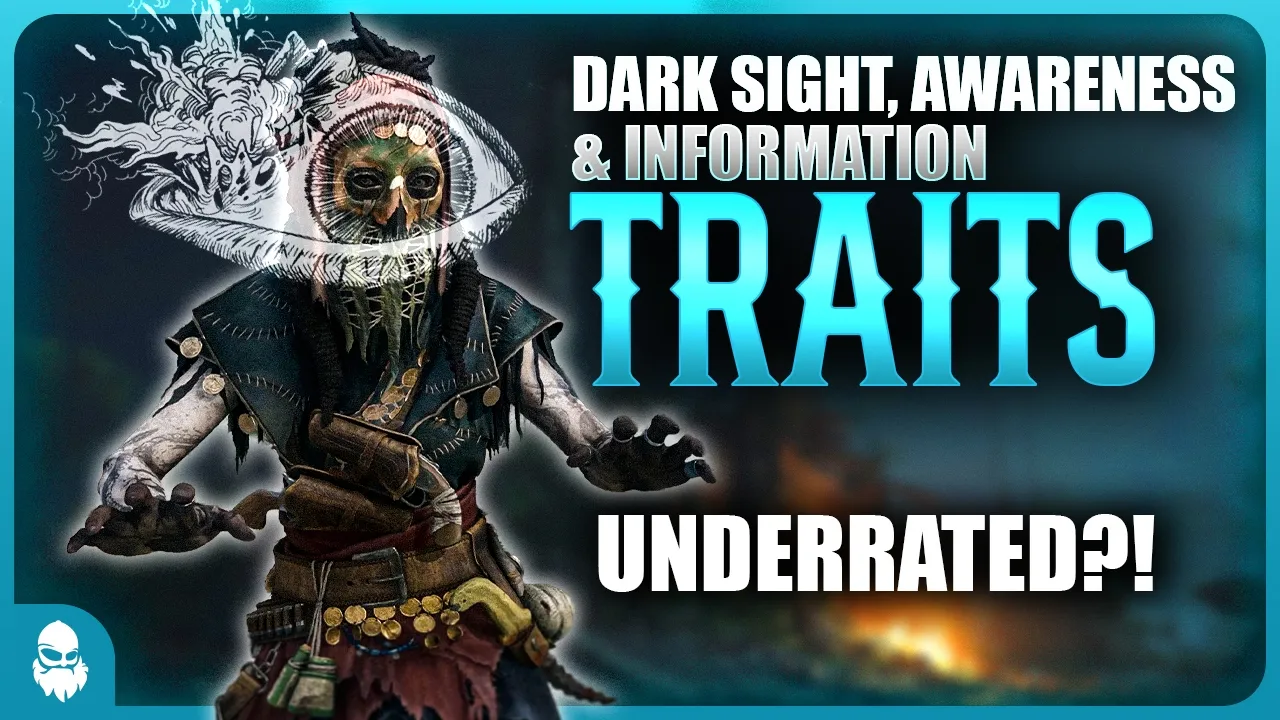
Dark Sight & Information Traits EXPLAINED! Full Guide & Tier List | Hunt: Showdown 1896
Intro:
Hi guys, Rex here,
and welcome back to my Ultimate Trait Guide & Tier List series for Hunt: Showdown 1896.
In the last part, we covered melee, throwables, and special weapons — traits that are often tied to specific loadouts and close-range playstyles, and can have a huge impact when used correctly.
Today, we’re shifting focus once again — this time into Dark Sight, awareness, and information. These traits don’t directly increase your damage or weapon performance, but instead give you a massive advantage through knowledge, positioning, and decision-making.
Some of these traits are incredibly powerful and can completely change how you approach fights, while others are much more niche or heavily dependent on your playstyle. In many cases, their value also scales directly with your game sense — the better you are at interpreting information, the stronger they become.
Just like before, I’ll break down exactly what each trait does, highlight key mechanics and interactions, and then rank them based on their real, practical impact.
So without further ado, let’s dive into it.
1. Blast Sense
First up, we have Blast Sense. This trait costs two points and highlights gunshots and explosions in Dark Sight up to 200 meters away.
That is an incredibly long range, and it means that every time someone shoots, throws an explosive, or blows something up, it will be visible to you in Dark Sight — and unlike Dark Sight Boost, this is unlimited.
Blast Sense is one of those traits that a large portion of the player base never really uses, even though it is incredibly strong. I slept on it myself for a long time, mainly because I considered it somewhat unnecessary and a bit of a crutch.
And to some extent, that’s still true. If you rely on it too much, you miss out on valuable practice in reading fights and pinpointing players based purely on audio.
But at the same time, Blast Sense actually becomes more powerful the better you are. A skilled player can already estimate where shots are coming from — but Blast Sense takes that a step further. It helps you pinpoint exact locations quicker, gives you a clear indication of how many are involved when multiple markers appear at once, and helps you quickly confirm positions that would otherwise be uncertain.
It can be especially useful for tracking hidden or repositioning players. You might already have a rough idea of where they are, but Blast Sense removes the guesswork and gives you that exact confirmation.
This has quickly become one of my favorite traits in the entire game, and I usually always pick it when I can. That said, I’ve also noticed that not running it feels worse than before, so it’s worth being mindful not to rely on it too heavily.
Overall, this is one of the best information-gathering traits in the game at a very low cost, and it scales incredibly well with skill and game sense. And for that reason, I’m placing Blast Sense in the S tier.
2. Serpent
Next up, we have Serpent. This trait costs four points and allows you to interact with clues, rifts, banishable targets, and bounty tokens from a distance using Dark Sight. This also applies in beetle view, with the exception of bounty token interactions. Serpent has 25-meters range by default, but for solos the interaction range is increased to 50 meters.
Serpent is a great trait if you want to minimize risk and avoid exposing yourself. You can safely collect clues, start a banish on a dead boss, or pick up bounty tokens without having to physically move into dangerous positions.
With a beetle available, you can even fly away from your position and interact with clues from a distance, which adds another layer of safety and flexibility.
Serpent becomes especially useful in certain situations. For example, if a bounty token drops in a hard-to-reach area, or if a team is slow to pick it up after a banish, Serpent gives you the option to secure it safely. It’s also very useful against solos who can’t carry both tokens, allowing you to grab the second one without committing to a push.
For solo players, the extended range makes this even more reliable and can give you a noticeable edge in how you approach objectives.
Overall, Serpent is an excellent trait at a reasonable cost, but not usually a top priority for me. There are so many strong traits in the current meta that it often gets outvalued in most builds.
Because of how impactful it can be in the right situations — especially for slower or more methodical playstyles — I’m placing Serpent in the B tier. It’s very solid, but still optional and highly preference-based.
3. Vigilant
Next up, we have Vigilant. This trait costs one point and allows you to see nearby traps and active beetles in Dark Sight up to 25 meters. This can be doubled to 50 meters with Catalyst, like we covered earlier.
Traps are extremely common in Hunt: Showdown. Bear traps are scattered around compounds and are often hidden by terrain or clutter, and on top of that, many players bring their own traps into the match. Getting caught in one mid-fight can easily be the difference between winning a push or getting sent straight back to the lobby.
With how flexible trap placement has become, it’s not always realistic to spot them visually in the middle of a fight. Vigilant removes that uncertainty entirely and allows you to safely scan a compound before pushing in, taking away the need to constantly check for traps on top of everything else.
It even lets you detect dark dynamite satchels in Dark Sight, which can be placed on surfaces and are often very well hidden. With some practice, you can use Vigilant to locate traps and trigger them safely with a well-placed shot, as long as your weapon can penetrate the surface.
This makes Vigilant an amazing tool for avoiding instant deaths, whether it’s from a hidden trap or a player setting up an ambush.
Because of its incredible utility at such a low cost, Vigilant has become a must-have trait for me. I almost never enter a match without it, and I highly recommend running it whenever you can.
And for that reason, I’m placing Vigilant firmly in the S tier.
4. Witness
Next up, we have Witness. This trait costs four points and allows you to see dead hunters and AI in Dark Sight. This also applies in beetle view.
Whenever AI is killed, it leaves behind a white line at the death location. This line slowly shrinks over time and disappears after two minutes, which allows you to estimate how recently the AI was killed.
Dead hunters work a bit differently. Their markers are permanent and include an orange dot at the base, making them easy to distinguish. This is incredibly powerful, as it allows you to track bodies during fights, confirm kills in chaotic situations, and gather information even if you weren’t directly involved.
The most practical use is keeping track of enemies and counting bodies. If you’re fighting a trio and aren’t sure whether someone got revived, a quick scan with Witness will immediately tell you how many players are still down.
It also opens up some advanced plays. For example, you can place a dark dynamite satchel on a body and wait in Dark Sight for the revive to happen, then detonate it to potentially kill both the revived player and their teammate.
For stronger AI like Meatheads and Brutes, the marker stays for the entire match, so keep that in mind — a full-length line doesn’t necessarily mean players were there recently.
One important thing to note is that Witness used to provide healing while using Dark Sight near dead bodies, but that effect has been removed. While that was a strong bonus, the real value of this trait has always been the information it provides.
In Hunt: Showdown, matches can have up to 12 players. If you’re able to account for all of them, including yourself and your teammates, you know you’re alone in the server — aside from potential solo revives. Witness makes this much easier by helping you locate and track bodies throughout the match.
Overall, Witness is an incredibly powerful information-gathering trait, and one I almost always pick up once I have the essentials covered.
And for that reason, I’m placing Witness firmly in the S tier.
5. Pain Sense
Next up, we have Pain Sense. This trait costs three points and allows you to see nearby hunters in Dark Sight if they are bleeding, poisoned, or burning. This also works in beetle view.
With Catalyst, this can be expanded further to also reveal hunters who are out of stamina, but that part is more situational and depends heavily on the enemy not running stamina shots or having an active four shot boon.
Pain Sense is a very playstyle-focused trait. It works best if you’re consistently applying status effects, such as bleeding from the bow, poison ammo, or fire. In those cases, it can give you strong tracking potential and open up some creative plays.
That said, it’s not something I usually prioritize. Even when I’m running builds that apply these effects, I rarely feel like I need it to keep track of my opponents.
Where it can really shine is in more niche setups. For example, if you run Sparks with poison ammo to leave a hunter at one health, you can follow up with a beetle. Since Pain Sense works in beetle view, you can track the target easily and finish them off. It’s a fun combo, and a hilarious meme loadout.
Overall, Pain Sense is a solid trait with a lot of potential, but it’s very situational and heavily dependent on your build.
For that reason, I’m placing Pain Sense in the C tier.
6. Magpie
Next up, we have Magpie. This trait costs one point and grants you three-shot effects when picking up a bounty token — antidote, stamina, and regeneration.
On its own, that’s a nice bonus, but the real value of Magpie comes from how it works for solo players.
When playing solo, Magpie doubles both the Dark Sight Boost you gain and your overall capacity. That means you get 10 seconds of boost when picking up a bounty — matching a team holding two tokens — but you also gain more from every additional source.
For example, taking a clue or looting a body normally gives 1 second of boost, but with Magpie as a solo, you get 2. In the case of the Moon tarot card, that increases from 2 seconds to 4.
This is incredibly powerful, because it effectively brings your scan potential in line with teams — and in some cases, even surpasses it.
At the end of the day, Magpie is rarely picked for team play, where its value is fairly limited, but it becomes one of the strongest traits in the game for solo players.
While I would consider it C tier for team play, Magpie is primarily a solo trait, and for that reason, I’m placing it in the S tier.
7. Poltergeist
Next up, we have Poltergeist. This trait costs two points and allows you to remotely interact with and manipulate world objects and animals from up to 50 meters away in Dark Sight. This also applies in beetle view.
This means you can open doors, ring bells, or trigger animals like crows and horses from a distance.
Poltergeist is one of those traits that can be very confusing to play against, because it’s not always obvious whether something was triggered manually or remotely. More experienced players can often figure it out, but it still creates uncertainty and can be used to your advantage.
In terms of utility, it can open up some interesting plays. For example, you can open a door from a distance to bait a peek, or open doors that are barred from the inside without too much making noise. I’ve personally gotten some nice kills using it this way.
That said, the biggest downside for me is how much it clutters your Dark Sight. With Poltergeist, every interactable object gets highlighted, which makes it harder to focus on more important information.
If it wasn’t for that, I would probably use this trait a lot more. But as it stands, I don’t feel like the utility consistently outweighs the downside.
For that reason, I’m placing Poltergeist in the C tier. It has a lot of potential, but it’s low on my priority list.
8. Blade Seer
Next up, we have Blade Seer. This trait costs one point and allows you to see retrievable projectiles in Dark Sight up to 75 meters away, which also works in beetle view.
This trait was already incredibly niche and not particularly useful before it got indirectly nerfed with Update 2.5. By default, you can now see projectiles in Dark Sight up to 25 meters without the trait — even in beetle view — which makes Blade Seer itself borderline useless.
That means the only real benefit you’re getting from this trait is an additional 50 meters of range. One benefit of that extra range would be tracking players from longer distances, so if you’re leaning heavily into a tracking-focused playstyle, it might still have some value. For most players, though, the default 25 meters is more than sufficient.
Because of that, the trait has gone from being niche to almost completely unnecessary. It’s very hard to justify spending a trait slot on something you already partially have by default — especially since the closest 25 meters are far more useful than the additional range from 25 to 75.
On a side note, the tracking aspect of the Blade Seer effect itself can still be useful — and this does not require the trait. If a projectile lands near you, you can enter Dark Sight and check the angle of the projectile to see the direction it was fired from, which can help you narrow down the enemy’s position even if you didn’t hear the shot. The trait does not change how this works — it only increases the range at which you can see the projectile.
Overall, I’m placing Blade Seer firmly in the D tier given the reasons I’ve covered. It’s simply not worth running in its current state and probably needs a rework.
Outro:
And that wraps up Part Six of my Ultimate Trait Guide & Tier List.
Today we covered Dark Sight, awareness, and information — the traits that give you an edge not through raw power, but through better reads, cleaner decisions, and more control over fights.
Some of these are among the strongest in the entire game when used well, while others are far more situational or depend heavily on your playstyle and how much you actually leverage the information they provide. And like we’ve seen throughout this series, it’s not just about how strong something is on paper — it’s about consistency, opportunity, and overall practical value.
If you found this helpful, make sure to subscribe so you don’t miss the final part. And if you disagree with any placements or think something deserves to move up or down, let me know in the comments — I’m always interested to hear your perspective.
Thanks for watching, and I’ll see you in the next one.