10 Extremely COMMON Beginner MISTAKES & How To Fix Them! | Hunt: Showdown 1896 (2026)
INTRO
Hunt: Showdown has a brutal learning curve, and when you’re new to the game, you’re probably making a lot of mistakes without even realizing it.
Some of them will get you killed immediately, while others can actually slow down your improvement for hundreds of hours.
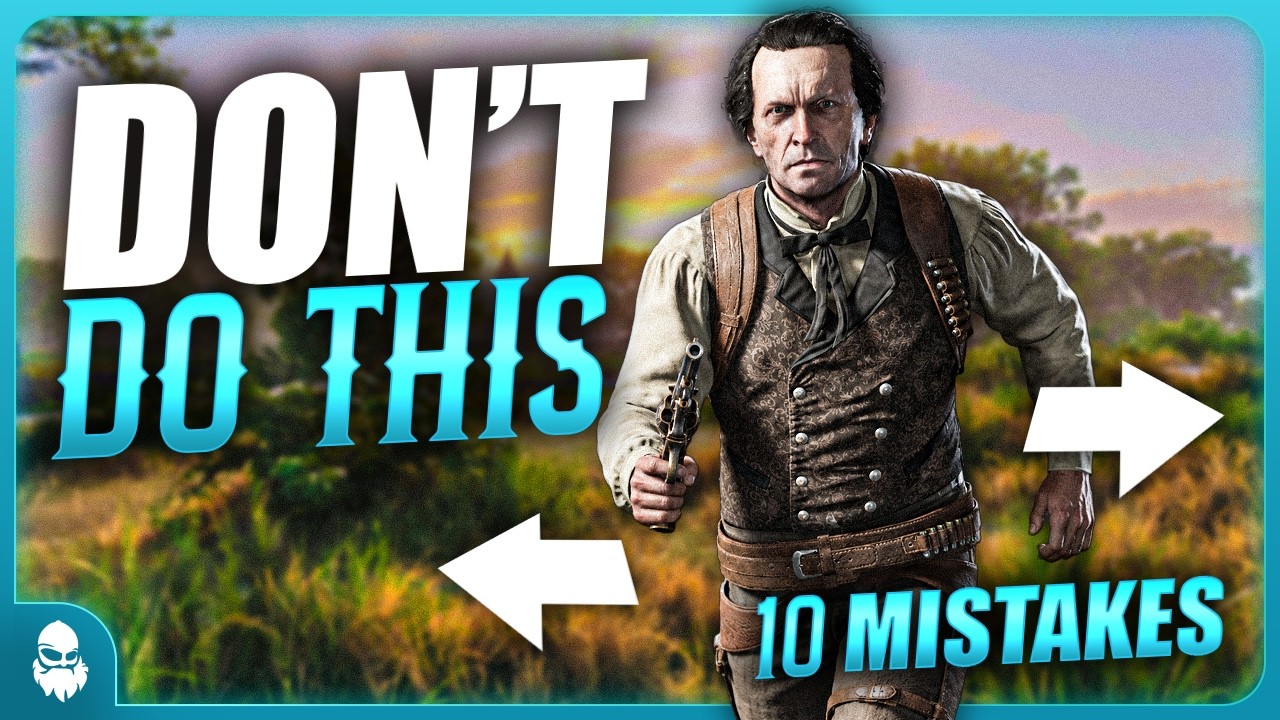
So in this video, we’re going through 10 of the most common mistakes I see beginners make, why they’re a problem, and most importantly, how you can fix them.
And even if you’ve been playing Hunt for a while, there’s a good chance you’re still making at least a few of these. Because after 8000 hours, I most certainly do from time to time.
But without further ado, let’s dive into it!
1. MOVING & POSITIONING YOURSELF POORLY
One of the first things you need to learn in Hunt is that how you move around the map can be just as important as having good aim.
New players tend to fall into one of two extremes.
They either sprint everywhere without thinking about who might hear or see them, or they become so afraid of making noise that they crouch-walk everywhere instead.
Neither is a good habit.
Crouching can be incredibly useful when you’re trying to get the drop on someone, but crouch-walking for an extended period of time also makes you an incredibly easy target.
On the other hand, if you’ve already been spotted, moving quickly and unpredictably is usually far more important than staying quiet.
Your positioning matters just as much.
Try to avoid unnecessarily exposing yourself in open areas, and whenever possible, move in a way that gives you access to cover if someone suddenly starts shooting at you.
A good habit is to regularly ask yourself this:
“If someone took a shot at me right now, where would I go?”
And if the answer is that you have no good options, that’s a clear sign that you need to work on your positioning.
There isn’t one correct way to move in Hunt. The important part is learning when you need speed, when you need stealth, and where you can take cover when the shit hits the fan.
2. MAKING TOO MUCH NOISE
Sound is one of the most important sources of information in Hunt, and beginners often don’t realize just how much information they’re giving away.
Just about everything you do makes noise, and because Hunt’s audio design is so complex and accurate, more experienced players can get way more information from even the quietest sounds without you even realizing it.
Running, jumping, vaulting, melee attacks, healing, switching equipment, and interacting with things around the map can all potentially tell another player where you are and where you might be going.
And then you have sound traps.
Crows, ducks, horses, dog pens, chicken coops, and other sound traps can reveal your presence from surprisingly far away.
And some of them can provide even more information than that.
Birds, for example, fly away from the player who triggered them, which can give an experienced player a pretty good idea of which direction you’re moving.
But the solution isn’t to spend the entire match trying to be completely quiet.
Sometimes triggering a sound trap and continuing to move is safer than slowly sneaking around it. And if another team already knows exactly where you are, there might be very little value in staying quiet at all.
The goal isn’t to make no noise.
It’s to understand what information your noise is giving away and whether that information actually matters.
3. BEING TOO PREDICTABLE
One of the easiest ways to get killed in Hunt is to become predictable.
A very common example is repeeking.
You peek a window, take a shot, and miss.
So you peek it again.
And again.
And eventually, the other player doesn’t even need to react to you. They can simply put their crosshair where your head appeared last time and wait for you to walk into it.
The same thing applies to movement.
If someone shoots at you, don’t simply run in a straight line. But also don’t fall into a perfectly predictable left-right-left-right pattern.
Change your timing, change your direction, and make it difficult for the enemy to predict your pattern.
This applies on a larger scale as well.
If you’ve taken several shots from the same spot, consider changing your angle or position entirely instead of feeding them information on a silver platter.
The more information you give an opponent, the easier you become to predict.
Never let them know your next move, and you’re already outperforming the majority of new players.
4. NOT PLAYING AROUND YOUR TEAMMATES
If you’re playing duos or trios, one of the biggest advantages you have is your teammates.
So use them.
One of the most common mistakes I see when playing solo against teams is players pushing me one at a time.
The first player pushes and dies.
Then the second player does the exact same thing.
And suddenly the third player is left in a duel they are far less likely to win, which often results in the same outcome.
Instead of fighting a team of three players, you’ve effectively given me three separate 1v1s.
And that is significantly easier to deal with, especially due to the game’s solo matchmaking modifier.
The teams that are hardest to fight are the ones that coordinate their pressure.
They attack from multiple angles, cover each other, focus on smart revives while applying pressure, and never let me catch a break.
That doesn’t mean all three should push from the same spot.
In fact, that’s often just as bad.
You want enough separation to create different angles, while staying close enough to actually support each other.
Pay attention to what your teammates are doing, and when one of them creates an opportunity, try to capitalize on it together.
I’ve made a full teamplay guide that goes much deeper into this, so if you want to improve how you play as a team, I’ll leave a link to that video in the description.
5. BEING OVERCONFIDENT
Confidence is good.
But overconfidence gets you killed.
Maybe you just landed a great shot and the enemy is low.
Maybe you’ve already killed two players and assume the last one will be easy.
Or maybe you simply think you’re better than the opponent.
That’s usually when people start making decisions they wouldn’t normally make.
They chase someone without healing.
They repeek from a predictable spot, simply because they landed a shot.
They leave their teammates behind because they desperately want to finish the kill.
Or they assume they’ve already won the fight before it’s actually over.
Hunt can punish a single mistake extremely quickly.
It doesn’t matter how much better you think you are if you walk straight into a shotgun.
When you gain an advantage, use it.
But don’t take the win for granted and make worse plays just because the odds are in your favor. Good players know that even a favorable fight can end badly and getting into a habit of making smart plays even when you don’t have to is the key to long term success.
6. OVERCOMMITTING TO FIGHTS
Another common mistake is feeling like every fight has to be finished simply because you started it.
Experienced players know when to back off, recover, reposition, or sometimes even abandon a fight entirely.
Typical examples are fights where you immediately lose your Necromancer trait as a solo, or a fight where one or more teammates are missing health chunks after dying, but you’re lacking recovery options.
Other times, it could be a fight where the enemy team has way better positioning or their loadouts are stronger for the fight, for example, an open field with sniper coverage while you’re rocking shotguns.
You don’t get bonus points for staying until you die.
Back off.
Rotate to a better position.
Recover your health or try to regain a Necromancer charge.
Let the other teams fight each other.
Then reassess the situation when you’re in a better position.
This applies on a smaller scale too.
If you start a push and suddenly realize the situation isn’t what you expected, you don’t have to finish that push.
If an angle isn’t working, you don’t have to keep fighting from it.
One of the most valuable things you can learn in Hunt is when to stop forcing something that isn’t working.
7. NOT SEEING THE BIGGER PICTURE
New players often focus almost entirely on what’s directly in front of them.
There’s an enemy in the building, so they push. The boss is dead, so they run over there in a straight line. There is a gunshot, so they immediately run toward it.
But Hunt gives you a lot more options than simply fighting whatever is directly in front of you.
Maybe you can rotate around the compound and set up a much better angle or block the route to the nearest extraction point.
Maybe your teammate can apply pressure while you set up a strong play.
Maybe another team is approaching, and the best decision is to let them engage first.
Or maybe you can move to higher ground for a tactical advantage.
The more experienced you become, the more you’ll start thinking about the entire situation and weighing your options instead of jumping to the most obvious one.
Instead of asking:
“How do I kill this guy?”
Try asking:
“What is the smartest play I can make in this situation, and what will happen if I do X?”
Ironically, changing your approach is much simpler than you think, and yet something very few beginners actually do.
8. FOCUSING ON THE OUTCOME, NOT THE JOURNEY
As a content creator, there are some questions I get all the time.
“Is a 1.2 KD good after X hours?”
“How do I get to 6-star as quickly as possible?”
Or “What MMR should I be after 200 hours?”
And I think focusing too much on questions like these can actually slow down your improvement.
Because now your goal isn’t necessarily to become better at Hunt.
Your goal is to make a number go up. And that number actually means very little in the bigger picture, because it doesn’t consider your playstyle, weapon choices, team size, and multiple other factors.
For example, if you’re desperately trying to protect your KD, you might start avoiding difficult fights or even avoid making stronger plays that could impact the numbers, such as using Necromancer as a distraction to clutch the fight.
Alternatively, you might farm KD by playing sniper scopes only, focusing on third-party opportunities and running from fights, not to mention abandoning the bounty entirely because the risk is too high.
If you’re trying to reach a certain MMR as quickly as possible, you might only rely on the strongest weapons and avoid anything that isn’t considered meta. But this also means missing out on a ton of experience and information that would make you a better player in the long term.
Making mistakes, trying new things, and putting yourself in difficult situations is part of learning.
You’re going to miss shots.
You’re going to make terrible pushes.
You’re going to try strategies that don’t work.
And you’re going to die.
A lot.
And that’s fine.
Don’t try to become a 6-star player as quickly as possible.
Try to become better at Hunt.
And if you do that, by the time you become 6-star, you’ll actually belong there.
9. REACTING INSTEAD OF ANALYZING
Winning doesn’t always mean you played well.
And losing doesn’t always mean you played badly.
This is an important distinction if you actually want to improve.
You can make a terrible decision, get lucky, win the fight, and walk away thinking you did everything correctly.
You can also make the right decision, play incredibly well, and still lose, simply because they were better or you just got unlucky. And at the end of the day, both things can be true at once.
If your only reaction after dying is:
“That weapon is broken.”
Or “My teammate screwed up.”
Or simply getting frustrated and immediately moving on to the next match, you’re throwing away an opportunity to learn something.
Instead, ask yourself what actually happened.
What did you do well?
What did you do poorly?
Was there something you could have done differently?
And this doesn’t only apply when you lose.
Some of the most useful mistakes to identify are the ones you made in games you still managed to win, because mistakes left unpunished are much easier to ignore.
Every match gives you information.
And the more objectively you can analyze what happened instead of reacting emotionally to the outcome, the faster you’ll improve.
10. GETTING ATTACHED TO GEAR & STRESSING OUT
Gear fear is extremely common in most extraction shooters, and Hunt is no exception.
You acquire an expensive weapon and suddenly you don’t want to use it because you might lose it. Or you rely entirely on budget loadouts because you only have X hunt dollars, even if your balance could sustain you for weeks.
The important lesson is this; gear and money left in your stash have absolutely no value, and avoiding good or expensive weapons will only hold you back from improving in the long term.
Ironically, once you put in some hours, you realize that money comes easy in Hunt, and even if you lose it all—the game gives you infinite access to free Hunters to keep going.
Additionally, when you care too much about surviving, your decision-making starts falling apart.
You get caught off guard, panic, and start firing shots as quickly as possible, hoping one of them lands.
Or you become so afraid of making a mistake that you hesitate until the opportunity is already gone.
I remember experiencing the exact same thing when I started playing games like Rust and Tarkov back in the day. The adrenaline would hit, and ironically, my fear of losing is exactly what led to losing anyway.
The only real way around this is experience.
Use your gear and money. It’s there for a reason.
Take fights.
Put yourself in uncomfortable situations.
And accept that sometimes you’re going to lose.
Try to stay calm enough to make deliberate decisions under pressure instead of letting the fear of losing make them for you.
After 8000 hours, I rarely ever get stressed out no matter how hectic the situation is. And the way I got there was by putting myself in those exact situations over and over again.
OUTRO
And those are 10 of the most common mistakes I see new Hunt players make.
The important thing is that you don’t need to fix all of them immediately.
Pick one or two things you recognize in your own gameplay and start paying attention to them. Once those become habits, move on to something else.
Hunt has an enormous learning curve, and becoming good at the game isn’t about finding one secret trick that suddenly makes everything click.
It’s thousands of small lessons that gradually add up.
And if you really want to ramp up your learning process, make sure to check out my guides and mastery series playlists, where I cover just about everything Hunt has to offer in much more detail.
I’ll leave a selection of my most relevant guides linked in the description, so you can easily find what you need!
And if you found this video helpful, leave a like and subscribe so you don’t miss upcoming videos!
Thank you so much for watching, and I’ll see you in the Bayou!