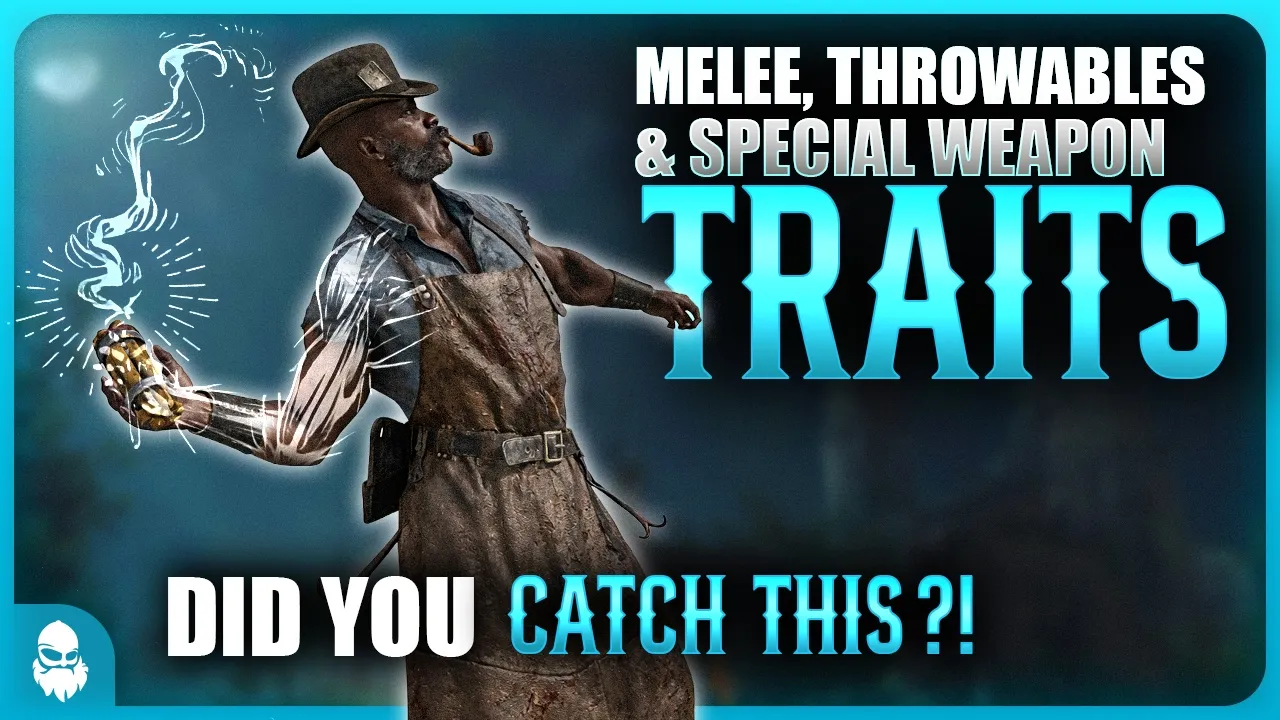
Melee, Throwables & Special Weapon Traits EXPLAINED! Full Guide & Tier List | Hunt: Showdown 1896
Intro:
Hi guys, Rex here,
And welcome back to my Ultimate Trait Guide & Tier List series for Hunt: Showdown 1896.
In the last part, we covered gunplay and weapon handling — the traits that directly impact how your firearms perform in fights, from rate of fire and reload efficiency to overall consistency and pressure.
Today, we’re shifting away from traditional gunplay and focusing on melee, throwables, and special weapons — the traits that affect close-range combat, utility, and some of the more unique playstyles in the game. Some of these traits can significantly enhance specific weapons, while others are much more situational or dependent on how you approach engagements. And some of them offer mechanics that aren’t immediately obvious.
Just like before, I’ll explain exactly what each trait does, highlight key mechanics and synergies, and then rank them based on real, practical value.
So without further ado, let’s dive into it!
1. Hundred Hands
First up, we have Hundred Hands. This trait costs two points and increases the damage of the Hunting Bow by 10% at full draw, which has a massive impact on its one-shot potential.
A bow kill comes down to three things: how much you draw the bow, where you hit the target, and whether you’re running Hundred Hands. Without Hundred Hands, a fully drawn bow will one-shot to the torso at 28 meters, the stomach at 19 meters, and the arms at just 6 meters. Leg shots never one-shot and cap out at 143 damage, even at point-blank range.
With Hundred Hands equipped, those ranges increase significantly. You get one-shot kills to the torso at 34 meters, the stomach at 23 meters, and the arms at 10 meters. It also enables one-shot kills to the legs within 7 meters, which isn’t possible without the trait.
In practice, that’s an increase of 6 meters for torso shots, 4 meters for stomach and arm shots, and it unlocks leg one-shots entirely. You can also visually tell if Hundred Hands is active — the arrow is pulled all the way back to the handle of the bow. Without it, the draw is shorter and slightly faster.
On top of that, Hundred Hands also reduces sway at full draw and allows you to use arrows for melee attacks. This was previously tied to a separate trait called Dewclaw, which has since been integrated into Hundred Hands. This ability is fairly slow and doesn’t deal particularly high damage for a melee attack, but it’s a nice addition and can be useful in certain situations.
Despite Hundred Hands being incredibly strong, I don’t consider it a must-have trait. The bow was buffed after the 1896 update and gained 10% flat damage across the board, which means it’s now stronger without the trait than it used to be with it before that update. In other words, the bow is still very viable on its own — but you should absolutely run Hundred Hands whenever you can.
And while most of you might expect this to be an S-tier trait, I’m actually placing Hundred Hands in the A tier. It’s highly recommended, but not required. And if you want a full breakdown of how to master the Hunting Bow, I’ve got an in-depth guide on the channel that goes much deeper than what I’m covering here.
2. Martialist
Next up, we have Martialist. This trait costs two points and currently only applies to the Katana, although Crytek has mentioned they may expand it to other melee weapons in the future.
Martialist allows you to sheath the Katana, enabling a very fast swipe attack directly from the sheath. Sheathing your weapon is bound to X on PC by default, or whatever your switch weapon mode key is assigned to. This attack has slightly increased range, swings in a wide arc, and deals massive damage — enough to kill any hunter it hits.
Unlike most melee attacks, which only hit a single target even if players are stacked on top of each other, this swipe has a cleave effect and can pass through multiple hunters. That makes it especially dangerous in close quarters or against grouped enemies as you can often land more than 1 kill with a single swing.
One important detail to be aware of is that the regular heavy attack with the Katana deals 140 damage to the legs, which means it won’t kill. With the sheath attack, you can one-shot to the legs as well, effectively making it a guaranteed kill regardless of where you hit.
It’s not just strong against players either. The attack is very effective against AI and bosses, and it can even be used to break locked wooden doors quickly, taking just two swings from the sheath.
Another key detail is that this attack does not require stamina. Without the trait, trying to melee with no stamina results in a slow and weak swing. With Martialist, you maintain full effectiveness even when you’re completely out of stamina, which adds a lot of consistency to the weapon.
Now, the Katana itself isn’t very common in higher MMR lobbies, but whenever you do run it, Martialist is absolutely worth it. Similar to Hundred Hands for the bow, the weapon is already strong on its own, but you’re definitely missing out if you don’t use the trait.
Because of how much it improves both the power and versatility of the Katana — and honestly, how much more fun it makes it to play — I’m placing Martialist in the A tier.
3. Silent Killer
Next up, we have Silent Killer. This trait costs three points and reduces the noise made when performing melee attacks.
If you’re leaning heavily into melee — for example with the Katana — this can definitely be useful. It removes the grunting sounds your hunter normally makes when attacking, which can help you stay undetected for longer.
It also removes the windup sound from heavy melee attacks, which is arguably the most useful part of this trait. Normally, your hunter takes a deep breath while winding up, and that alone can give you away if someone is about to walk into you. With Silent Killer, that cue is gone — which can make the difference between a failed or a successful ambush.
It’s not a perfect stealth tool, though. You’ll still make noise when killing players or AI, and the attacks themselves aren’t completely silent. Where this trait really shines is in chaotic, close-range situations, where the reduced audio can allow you to land multiple kills before enemies fully realize what’s happening. However, with good positioning and movement, you can usually achieve the same result even without the trait.
Overall, Silent Killer is not a trait I typically prioritize. While it’s always an upgrade, the question is whether that upgrade is worth both the three points and the trait slot compared to other options.
Because of that, I’m placing Silent Killer in the C tier. It’s a nice-to-have when it fits your build, but far from a must-have. For certain weapons and playstyles, it can definitely be very useful — so give it a try and decide for yourself.
4. Assailant
Next up, we have Assailant. This trait costs just one point and increases the melee effectiveness of throwing knives and throwing axes. It also changes the attack animations, which, on top of the gameplay benefits, looks awesome.
With throwing knives, your attacks change from swings to stabs. Light attacks become a one-handed stab, while heavy attacks turn into a two-handed stab. Without the trait, throwing knives deal 60 damage to the torso with heavy attacks, taking three hits to kill, or 120 to the head, taking two hits. Light attacks deal 30 damage to the torso, taking five hits to kill, or 60 to the head, taking three.
With Assailant, those numbers increase significantly. Light attacks deal 53 damage to the torso, taking three hits to kill, while heavy attacks deal 98, allowing you to kill in two heavy attacks or one heavy and one light. For headshots, heavy attacks will always kill, while light attacks deal 87 damage, reducing it to a two-hit kill instead of three.
For throwing axes, the animation changes to a more horizontal, slightly upward swipe. This benefits more from the cleave effect, allowing you to hit multiple targets and deal damage across a wider area.
Without the trait, throwing axes deal 75 damage to the torso with light attacks, taking two hits to kill. Heavy attacks deal 142 damage to the torso, and with the bleed effect, this will usually result in a quick kill unless they can react immediately.
With Assailant, light attack damage increases to 97, while heavy attacks remain at 142 — still resulting in an almost instant bleed-out if they don’t react. For throwing axes, headshots will always kill, both with and without the trait.
Overall, Assailant does offer solid melee value, and it can be useful if you’re running throwing weapons as a replacement for a regular melee weapon to create a more versatile loadout.
That said, both throwing knives and axes are currently outperformed by the throwing spear, which means most players don’t run them to begin with. And even if you do, the melee aspect usually isn’t the main reason you’re bringing them — especially in the case of throwing knives.
Because of that, this trait becomes a bit of a hard sell. You’re giving up a trait slot for something that’s cool, fun, and occasionally useful — but in most cases, you’d be better off just running the spear and saving both the trait point and the slot.
Because of how niche it is in the current meta, I’m placing Assailant in the C tier. It does provide real value if you fully commit to these weapons, but in most cases, it’s simply not worth the slot.
5. Pitcher
Next up, we have Pitcher. This trait costs four points and increases the throwing range for most throwables. While the description says it applies to all throwables, it does not affect throwing weapons like knives or axes, or world-found melee weapons like pitchforks, shovels, axes, or hammers.
Instead, it applies to tools and consumables such as dynamite, fire bombs, concertina bombs, choke bombs, and more. From my testing, it even extends to things like lanterns and beetles.
Pitcher is one of those traits that is incredibly nice to have, but rarely something I prioritize. That’s not because it lacks usefulness, but because it falls into that category of strong utility that isn’t strictly necessary. If trait slots were unlimited, this would be an easy pick — but in practice, it often gets outvalued by more impactful traits.
That said, Pitcher becomes very strong if you’re consistently bringing explosives. For example, if you’re doing challenges that require damage with frag bombs, or if you’re leaning into a more explosive-focused playstyle, this trait becomes much more valuable.
It also has great synergy with Surefoot, allowing you to sprint at full speed while throwing consumables. That combination can be very hard to react to, especially when you’re cooking a dynamite and throwing it further than enemies expect.
In fact, the biggest strength of Pitcher is the unpredictability it creates. You can land throws from positions and distances that players simply don’t anticipate, which can lead to very strong plays and catch enemies off guard.
Because of that, I’m placing Pitcher in the B tier. It’s a very useful trait with strong situational value.
6. Bolt Thrower
Next up, we have Bolt Thrower. This trait costs three points and reduces the reload time for crossbows, the bomb lance, and the bomb launcher.
This is a highly recommended trait if you’re playing any of these weapons, because they all have slow reload speeds. Being able to reload faster makes a huge difference, as it allows for much quicker follow-up shots.
Back in the day, this trait only applied to crossbows — including the hand crossbow — but has since been expanded to include the bomb lance, the bomb launcher and the Chu Ko Nu as well.
In practice, this trait effectively cuts your reload time in half. For example, the crossbow goes from 5.3 seconds down to 2.65, the hand crossbow from 4.3 to 2.15, the Chu Ko Nu from 8.5 to 4.25, the bomb lance from 6.9 to 3.45, and the bomb launcher from 5.1 to 2.55 seconds.
That is a massive increase in tempo and overall pressure in combat.
Because of how much it improves your ability to land follow-up shots and stay in the fight, Bolt Thrower is almost essential if you’re committing to any of these weapons, and for that reason, I’m placing it in the A tier.
Outro:
And that wraps up Part Five of my Ultimate Trait Guide & Tier List.
Today we covered melee, throwables and special weapons — the traits that are often tied to specific loadouts and playstyles, but can have a huge impact when used effectively.
Some of these traits can significantly enhance individual weapons, while others are much more situational or depend heavily on how you approach engagements. And as always, it’s not just about how strong a trait is on paper, but how often you actually get value from it and what you’re giving up in return.
In Part Six, we’ll be diving into Dark Sight, awareness and information traits and continuing to flesh out the full tier list piece by piece.
If you found this helpful, make sure to subscribe so you don’t miss the next part. And if you disagree with any placements or think a trait deserves to move up or down in the tier list, let me know in the comments — I’m curious to hear your opinion!
Thanks for watching, and I’ll see you in the next one.