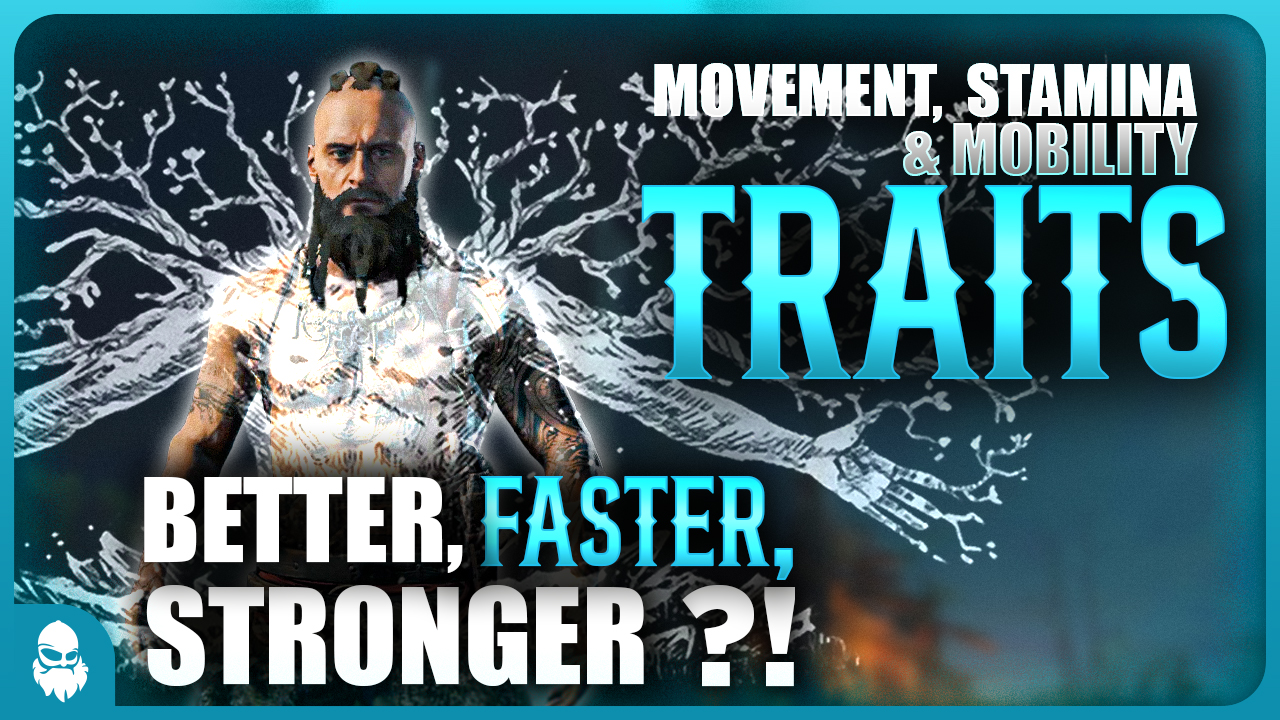
The ULTIMATE Hunt: Showdown 1896 Trait Guide & Tier List | Part 3 – Movement, Stamina & Mobility
Intro:
Hi guys, Rex here,
And welcome back to my Ultimate Trait Guide & Tier List series for Hunt: Showdown 1896.
In the last part, we covered Healing, Restoration, and Damage Mitigation — the traits that determine how long you stay alive once a fight starts. But survivability is only half the equation. Today, we’re talking about what happens before and during engagements: movement, stamina management, repositioning, and overall tempo control.
Some of the traits in this category look incredible on paper but fall off depending on how you manage your consumables. Others are incredibly niche and map-dependent. And one of them is, in my opinion, one of the strongest traits in the entire game.
Just like before, I’ll explain exactly what each trait does, highlight key mechanics and synergies, and then rank them based on real, practical value in both solo and team play.
So without further ado, let’s dive into it!
1. Greyhound
First up in this category, we have Greyhound. This trait costs two points and allows you to sprint for longer before depleting your stamina. Without Greyhound, you can run for 34 seconds. With it, you can run for 68 seconds — in other words, twice as long.
That sounds very strong on paper, and it definitely can be if you’re not running stamina shots in your build. Being able to move efficiently for longer, chase more aggressively, or reposition without stopping is valuable. But here’s the catch: as long as you have a stamina buff active, Greyhound does absolutely nothing for you.
I always bring a large stamina shot into my games and then replenish with four-shot boons or looted stamina shots along the way. Because of that, Greyhound is not a trait I ever pick. Even though this trait only costs two points, the slot investment is what really matters. Early on, before you fill up your slots, Greyhound can offer good value at a low cost. But once your Hunter is leveled up and has access to more impactful traits, Greyhound should probably make way for something more useful, in my opinion.
If you’re someone who doesn’t run stamina shots, Greyhound can absolutely be worthwhile. But with the implementation of four-shot boons as a core mechanic, it’s rarely necessary.
Because it’s solid but generally not worth the slot in my opinion, I’m placing Greyhound in the C tier. It certainly has a place in some builds, but it’s completely optional.
2. Determination
Next up, we have Determination. This trait applies to both sprint stamina and melee stamina. Like we covered earlier, after sprinting for about half a minute, you run out of stamina and have to slow down to catch your breath before you can continue. That recovery window usually takes 3 seconds, but with Determination, the recovery time is cut in half to 1.5 seconds.
The same applies to melee stamina. After spending stamina through melee attacks, it normally takes 3 seconds before it starts recovering again. With Determination, that drops to 1.5 seconds, which can be very useful if you’re running a melee focused build.
On paper, Determination is very powerful. And if you combine it with Greyhound, you can run twice as long and take shorter breaks, which sounds great in theory. But the issue is the same as before — you’re now sacrificing two trait slots for stamina management, which is rarely something you can justify in a late build without holding yourself back.
And just like Greyhound, Determination has no effect while a stamina buff is active. That means for large portions of most matches, the trait is completely redundant.
So while Determination is strong in isolation and perfectly reasonable as an early pick for a low cost, it doesn’t usually make the cut in optimized builds. For the same reasons as Greyhound, I’m placing Determination in the C tier. It’s solid, but completely optional.
3. Adrenaline
Next up, we have Adrenaline. This trait costs just one point and gives you a small stamina boost when entering critical health.
At first glance, that might sound useful, but in practice it suffers from many of the same issues as the previous stamina traits. It only activates when you enter critical health, which already makes it highly situational. And just like Greyhound and Determination, it does absolutely nothing if a stamina buff is active.
One potential use of Adrenaline is getting revived in team play without Resilience, since you would stand up at low health and immediately gain some stamina. But since Resilience is essentially a must-have trait for team play, that interaction rarely becomes relevant.
For solos, the interaction has slightly more value. Even though self-revives grant full Restoration and instantly refill your health, the game briefly registers you as being in a critical state the moment you stand up from being downed. That short window is enough to trigger Adrenaline, giving you a stamina burst right as you get back on your feet.
At the end of the day, the effect barely matters because of how situational it is. There are moments where it can be helpful, but you’re almost always better off taking something that provides more consistent value.
Because of that, I’m placing Adrenaline in the D tier.
4. Gator Legs
Next up, we have Gator Legs. This trait costs three points and allows you to walk and sprint faster in deep water, while also making less noise when crouched in water.
On paper, that sounds great. But in practice, how useful this trait is depends heavily on the map. Back when Stillwater Bayou was the only map, Gator Legs arguably had some real value. But on the other maps, water is far less common, and in general, most players try to avoid spending time in deep water anyway. It makes you a sitting duck with limited cover and very little ability to defend yourself.
You could argue that Gator Legs helps mitigate that weakness by letting you move more efficiently and quietly through water, especially in stealth-focused builds. But even then, it remains incredibly niche. You’re essentially investing a trait slot into something that only matters in very specific parts of certain maps.
For what it does, I don’t think it’s worth either the points or the slot, and I never pick it. Because of how map-dependent and situational it is, I’m placing Gator Legs in the D tier, and I think it could use a buff to make it more consistently valuable across all maps.
5. Kiteskin
Next up, we have Kiteskin. This trait costs just one point and cuts fall damage by about a third. For a single trait point, that’s actually very solid value.
With Catalyst, Kiteskin also prevents you from dying to fall damage entirely. That’s obviously a bit situational, since you need both traits and a scenario where fall damage would otherwise kill you — but those situations do happen occasionally, especially on vertical maps like Mammon’s Gulch or during chaotic fights.
Kiteskin is one of those traits I actually pick very frequently on new Hunters because the value per cost is so high. It’s a perfect filler trait for one point. You’ll feel the benefit across the match without having to think about it. That said, in later builds, when you have access to stronger and more impactful traits, it’s usually one of the first things I replace.
Because it offers consistent value and strong efficiency for the cost, but isn’t a top priority in optimized builds, I’m placing Kiteskin in the B tier.
6. Lightfoot
Next up, we have Lightfoot. This trait costs five points and allows you to vault, fall, and climb ladders silently. It also reduces the noise made when walking through sound traps.
If there’s one thing Hunt: Showdown does exceptionally well, it’s audio design. Every movement, every action, every mistake can be heard by trained ears. So being able to perform normally loud actions without giving yourself away can give you a serious edge. Climbing a ladder for a new angle without anyone realizing, vaulting a fence without announcing your position — those moments absolutely matter.
When it comes to falling, it’s a bit more situational. You’ll still make noise if you take fall damage, so you can’t drop from extreme heights without being heard. But for lower drops that don’t cause damage, the sound is masked, which can be very useful during repositioning.
Lightfoot is a solid trait for the price and definitely worth the slot if you’re leaning into a stealth-oriented playstyle. It’s honestly a trait I should probably use more than I currently do. Because it’s powerful but somewhat expensive and more build-dependent, I’m placing Lightfoot in the B tier — though I can absolutely see why some players would consider it A tier depending on how they approach the game.
7. Surefoot
Next up, we have Surefoot. This trait costs six points and allows you to sprint while holding primed throwables, first aid kits, and consumables. That applies to a huge range of items — throwing weapons, explosives, concertina bombs, medkits, you name it.
Surefoot enables offensive, defensive, and tactical plays all at once. You can rush in while charging an explosive, close distance with a throwing weapon ready, or retreat at full speed whilst healing with your medkit. It effectively removes the biggest downsides of these items — the movement penalty — and allows you to play faster and more decisively under pressure.
When you combine Surefoot with Doctor, Physician, and Frontiersman, the synergy becomes absurd. You’re healing twice as much in nearly half the time, with extra charges available, all while sprinting at full speed. That combination alone can completely change the outcome of fights.
In my opinion, Surefoot is easily S tier and one of the best traits in the entire game. It saves more lives than almost any other trait simply because of how much flexibility it gives you.
8. Conduit
Next up, we have Conduit. This trait costs five points and grants you three minutes of stamina and a fifty health boost when you interact with a clue. In team play, every player who has Conduit active receives the effect when a clue is taken.
For solos, Conduit works a bit differently. Taking one clue activates a second automatically, meaning you progress twice as fast toward locating the boss, and you receive twice the effect — six minutes of stamina and one hundred health. If you take two clues solo, that means twelve minutes of stamina, which is very strong. And yes, you get the double effect even if there is only one clue remaining in the area.
There is a small downside for solos, though. Because two clues activate at once, you don’t see the map greyout progress gradually. Since the greyout is identical for all teams, this can make it harder to track rotations and predict where other players are moving.
The stamina effect itself is clearly powerful, and the healing can be useful in situations like early spawn fights. But for team play, I personally don’t think it justifies the five-point cost and the trait slot. I always bring stamina shots and rely on four-shot boons found in game, which makes Conduit feel redundant in most of my builds.
For that reason, I’m placing Conduit in the C tier for team play. For solos, I rate it slightly higher and place it in the B tier, since the additional stamina and information you gain in the early game can be very impactful.
Outro:
And that wraps up Part Three of my Ultimate Trait Guide & Tier List.
Today we covered Movement, Stamina, and Mobility — traits that determine how quickly you can reposition, push advantages, or disengage when things go wrong.
Some of these traits offer early-game efficiency, while others scale incredibly hard into late builds and high-pressure situations. As always, the real cost isn’t just the trait points — it’s the slot investment and what you’re giving up in return.
In Part Four, we’ll be diving into gunplay & weapon handling and continuing to flesh out the full tier list piece by piece.
If you found this helpful, make sure to subscribe so you don’t miss the next part. And if you disagree with any placements or think a trait deserves to move up or down in the tier list, let me know in the comments — I’m curious to hear your opinion!
Thanks for watching, and I’ll see you in the next one.